New Corporate Trainer Guide to Communication and Rapport Post
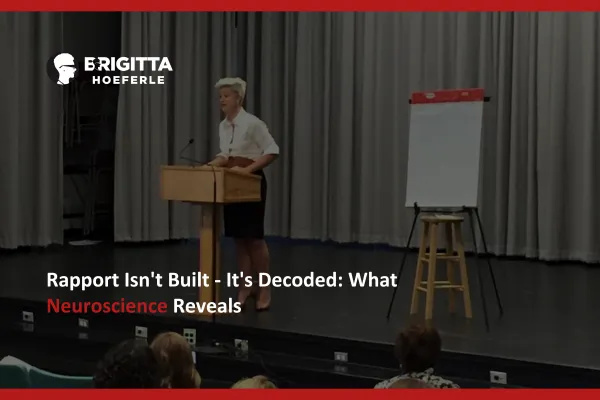
Rapport Isn't Built - It's Decoded: What Neuroscience Reveals
A trainer walks into a conference room with polished slides, strong credentials, and a carefully planned agenda.
Within minutes, the room begins sending signals.
One participant leans forward and takes notes. Another keeps checking email. A department leader listens with folded arms. Several employees nod politely, yet no one volunteers an opinion.
The presentation may be organized. The content may be valuable. But unless the trainer understands what is happening beneath the surface, the session can quickly become one-way communication.
An effective corporate trainer does more than speak clearly. They recognize how people process information, interpret language, respond to authority, and decide whether a conversation feels relevant and trustworthy.
That is where rapport begins.
Corporate trainers build rapport by reading verbal and nonverbal communication cues, listening for the concern behind a question, and adapting their delivery without losing the purpose of the session. It is not about performing friendliness. It is about helping people feel understood enough to participate, question, practice, and apply what they learn.
What Does It Mean to Decode Communication?
Communication decoding is the ability to notice how people receive, interpret, and respond to a message.
The words being spoken matter, but they are only one part of the exchange. Participants also respond to:
Tone and pacing
Facial expression
Physical posture
Energy in the room
Word choice
Level of detail
Emotional context
Perceived relevance
The trainer’s willingness to listen
A skilled communication skills trainer notices these signals without immediately assigning meaning to them.
Folded arms do not automatically indicate resistance. Silence does not always mean disengagement. A participant who asks several detailed questions may not be challenging the trainer; they may simply need more evidence before accepting a new idea.
The goal is not to become a mind reader. It is to become more observant and test assumptions before reacting to them.
Instead of thinking, “This audience is difficult,” an experienced trainer asks:
What might this audience be communicating, and what do they need from me right now?
That question shifts the trainer from delivering information to leading a learning experience.
Why Rapport Matters in Corporate Training Programs
Rapport is often treated as something a trainer establishes during the opening icebreaker. In reality, it shapes the entire session.
When people trust the learning environment, they are more likely to:
Ask honest questions
Admit when a concept is unclear
Share relevant workplace experiences
Participate in practice exercises
Challenge ideas constructively
Consider unfamiliar perspectives
Apply the material after the session
Without that trust, even well-designed corporate training programs can become passive presentations. Employees attend, take notes, complete an evaluation, and return to the same habits.
Professional rapport does not mean that everyone likes the trainer or agrees with every idea.
It means participants believe the trainer understands their reality, respects their experience, and can guide the conversation without dismissing concerns or forcing participation.
That kind of connection creates the conditions for learning.
Rapport Is Built Through Attention, Not Performance
Many rapport techniques fail because participants can feel the technique being used on them.
Forced enthusiasm, exaggerated agreement, repeated use of someone’s name, and obvious body-language mirroring can feel manipulative rather than authentic.
Real building rapport in corporate training begins with attention.
Before trying to influence the room, the trainer needs to understand it.
That means noticing:
What pressures participants are facing
What they expect from the training
What concerns may be limiting participation
What language they use to describe their work
What previous experiences may shape their attitude
What would make the session useful to them
Participants rarely feel understood because a trainer copied their posture. They feel understood because the trainer listened, acknowledged what mattered, and responded intelligently.
Five Communication Signals Every Corporate Trainer Should Decode
1. The Emotional Temperature of the Room
Every training session begins within an existing context.
Participants may be coming from a difficult meeting, a demanding deadline, an organizational change, or a busy customer-facing shift. Ignoring that reality can make the trainer seem disconnected before the session has properly begun.
A brief acknowledgment can establish credibility:
“I know several teams are managing tight deadlines right now, so we will keep today’s discussion practical and focused on tools you can use immediately.”
This does not lower expectations. It shows awareness.
The trainer is telling the room, “I see the conditions in which you are being asked to learn.”
2. The Language Participants Naturally Use
People reveal how they think through the words they choose.
An operations team may speak about speed, consistency, and execution. Human resources leaders may focus on trust, alignment, and employee experience. Senior executives may frame the same challenge around risk, performance, or strategic outcomes.
An effective corporate leadership trainer listens to that language and uses it to make the material more relevant.
This is not about repeating corporate jargon. It is about translating the learning into a frame the audience already understands.
For example, active listening may be presented to one group as a relationship-building skill. For another, it may be positioned as a way to reduce mistakes, prevent repeated clarification, and improve execution.
The principle stays consistent. The framing changes.
3. Participation Patterns
Notice who speaks first, who speaks frequently, and who remains quiet.
In many rooms, one or two confident voices begin shaping the entire discussion. If the trainer depends only on open questions, valuable perspectives may never be heard.
Strong trainers create more than one way to participate:
Private reflection before discussion
Conversations in pairs
Small-group problem-solving
Written responses
Scenario-based exercises
Short contributions from each table
This makes participation more accessible without forcing anyone into an uncomfortable public response.
It also gives the trainer a more accurate understanding of the room rather than relying on its most vocal members.
4. The Concern Beneath the Question
A participant asks:
“Will this actually work in our department?”
The surface question is about effectiveness. The deeper concern might be lack of time, limited authority, previous failed initiatives, or distrust in leadership follow-through.
Other questions may sound like this:
“Who is responsible for implementing this?”
“What happens when the other person refuses to cooperate?”
“Has senior leadership agreed to this?”
“How are we supposed to do this with our current workload?”
An inexperienced trainer may defend the material immediately.
A stronger corporate trainer listens for what the participant is really asking.
A useful response might be:
“It sounds like the concern is not whether the approach makes sense in theory, but whether it can work when time is limited and other people are not equally committed. Is that accurate?”
That response lowers defensiveness because it addresses the real issue rather than winning an argument.
5. Changes in Attention and Energy
Attention is not constant.
Participants may disengage when the content becomes too theoretical, repetitive, predictable, or disconnected from their responsibilities. They may also become quieter when a topic touches a sensitive workplace issue.
Watch for changes such as:
Less eye contact
Increased phone use
Side conversations
Shorter responses
Fewer questions
A sudden drop in participation
These signals do not automatically mean the session is failing. They indicate that the trainer needs to make a decision.
That decision may involve shortening an explanation, asking a sharper question, introducing a workplace example, changing the activity, or inviting participants to identify the barrier themselves.
Effective corporate trainer communication techniques are responsive. The agenda provides direction, but the trainer still has to lead the people in the room.
Listen Beyond the First Layer
Most people listen for enough information to prepare their response.
Experienced trainers listen for meaning.
They pay attention not only to what is said, but also to the intention, assumptions, concerns, and behavioral patterns behind the words.
This deeper listening is closely aligned with Brigitta Hoeferle’s 5-Star Listening™ methodology, which teaches leaders to move beyond surface-level hearing and recognize communication at multiple levels. It is designed to strengthen trust, influence, and leadership effectiveness.
For trainers, deeper listening means asking:
What is the participant saying directly?
What might they be trying to protect?
What assumption is shaping their response?
What information may be missing?
What outcome are they hoping to create?
What question would help clarify the real issue?
This is not an invitation to overanalyze every sentence. It is a discipline of remaining curious long enough to understand before responding.
Decode First, Then Encode the Message
Once trainers understand how the audience is receiving the communication, they can decide how to present the message more effectively.
This is the second half of the process: encoding.
Encoding means deliberately shaping the language, examples, structure, and delivery so the message is easier to understand and apply.
A well-encoded training message answers five practical questions:
Why does this matter?
What does it mean?
What does it look like in real behavior?
What could prevent it from working?
What should participants do next?
Consider these two statements:
“Managers need to practice active listening.”
And:
“Before responding to an employee’s concern, summarize what you believe they are saying and ask whether you understood correctly.”
The first statement identifies a broad goal.
The second gives the participant a behavior they can recognize and practice.
For trainers, communication deconstruction means separating a broad message into its language, delivery, emotional cues, assumptions, and desired behavior. Once those elements are clear, the trainer can rebuild the message in a form the audience can actually use.
How to Adapt Without Losing Authority
Some trainers worry that adapting to the audience will make them appear less confident or authoritative.
The opposite is often true.
Authority is weakened when a trainer appears defensive, disconnected, or unable to handle an unexpected question. It becomes stronger when the trainer demonstrates calmness, clarity, competence, and behavioral flexibility.
A trainer can build rapport while maintaining authority by:
Setting clear expectations
Explaining why an activity matters
Addressing difficult questions directly
Respecting the group’s time
Redirecting unproductive conversations
Admitting when more information is needed
Connecting every exercise to a practical outcome
Rapport does not require constant agreement.
A trainer can respectfully challenge an assumption while preserving trust:
“I understand why that approach may feel faster. Let’s examine how much time the team loses when the message has to be clarified three times afterward.”
The participant’s perspective is acknowledged, but the learning objective remains intact.
A Practical Framework for Building Rapport
Corporate trainers can use a simple five-step process to make rapport more intentional.
Observe
Notice the room before deciding what people’s behavior means.
Pay attention to energy, language, participation, and changes in attention.
Ask
Use questions to test your interpretation.
A question creates clarity. An assumption creates distance.
Acknowledge
Recognize the concern or context without becoming defensive.
People are usually more willing to consider guidance after they know their perspective has been heard.
Adapt
Adjust the example, format, pace, or language while preserving the session’s purpose.
Adaptation is not abandoning the plan. It is choosing the best route toward the outcome.
Apply
Turn the discussion into a practical behavior participants can use after the training.
Rapport is valuable because it supports learning and implementation—not because it creates a pleasant room for an hour.
This gives corporate trainers a repeatable strategy for building connection without relying on artificial techniques.
Common Mistakes That Weaken Trainer Rapport
Beginning With a Long Personal Introduction
Trainers sometimes spend too much time explaining their credentials.
Participants are usually more interested in whether the session understands their problem.
A concise introduction is enough. Credibility is then established through relevant insight, intelligent facilitation, and practical application.
Using the Same Delivery for Every Audience
New managers, experienced executives, customer service teams, and technical specialists should not receive identical examples and exercises.
The underlying principle can remain consistent while the language and application change.
Confusing Entertainment With Engagement
A loud, energetic room is not always a learning room.
Stories, humor, and activities can support the session, but every element should lead participants toward clearer understanding or stronger behavior.
People should leave with more than a memorable experience. They should know what to do differently.
Following the Slides Instead of the Conversation
Slides should support the learning, not control every decision.
When the room needs clarification, discussion, or a practical example, the trainer should be willing to pause the presentation.
Forcing Participation
Calling unexpectedly on quiet participants can create anxiety rather than engagement.
Provide structured opportunities to contribute instead of demanding public disclosure.
Avoiding Resistance
Resistance is often useful information.
It may reveal a practical barrier, a lack of trust, a poorly explained expectation, or a previous experience the organization has failed to address.
The trainer’s role is not to eliminate every objection. It is to understand what the objection is communicating.
What Should an Organization Look for in a Corporate Trainer?
Organizations searching for a corporate trainer should look beyond presentation skills and impressive stage presence.
A strong trainer should be able to:
Customize the content for the audience
Connect concepts to real workplace situations
Facilitate difficult conversations professionally
Recognize behavioral and communication patterns
Adapt without losing the learning objective
Provide tools employees can apply after the session
Work effectively with leaders at different levels
Explain how the training supports organizational priorities
The best corporate training programs do not simply leave participants inspired. They help people understand what needs to change, why it matters, and how to practice the new behavior in daily work.
For leadership development, organizations should also consider whether the trainer can help executives examine the effect their communication has on decision-making, trust, accountability, and execution.
How Corporate Leadership Trainers Create Practical Change
A corporate leadership trainer has an additional responsibility: helping leaders understand that communication is measured by what other people receive—not only by what the leader intended to say.
A leader may believe expectations were clear because the message sounded clear from their own perspective.
But the real questions are:
What did employees understand?
What did they repeat to others?
What action did they take?
Where did they need clarification?
Did the leader’s behavior reinforce the message?
Leadership communication becomes more useful when it moves beyond polished delivery and examines workplace consequences.
For example, a vague request such as “Improve communication across departments” is difficult to apply.
A practical behavioral expectation would be:
“At the end of each cross-department meeting, confirm who owns each action, what completion looks like, and when the next update is expected.”
That is specific enough to observe, practice, and evaluate.
How to Know Whether Rapport Is Working
Rapport should create visible changes in the learning environment.
Signs of stronger rapport may include:
More specific questions
Participation from a wider range of people
Honest discussion of obstacles
Better workplace examples
Constructive disagreement
Willingness to practice unfamiliar behaviors
Clear connections between training and job responsibilities
Feedback should also measure more than whether participants enjoyed the session.
Useful questions include:
Did the facilitator understand the challenges of your role?
Were the examples relevant to your work?
Did you feel comfortable asking questions?
Can you identify one behavior you will apply?
What could make implementation difficult?
These questions provide more meaningful insight than a general satisfaction score.
Frequently Asked Questions
What makes a corporate trainer effective?
An effective corporate trainer combines subject expertise with listening, facilitation, behavioral awareness, adaptability, and practical application. They understand both the content and the people expected to use it.
How can corporate trainers build rapport quickly?
Corporate trainers can build rapport faster by acknowledging the audience’s reality, asking relevant questions, listening without rushing to respond, and connecting the session to real workplace concerns.
What are effective corporate trainer communication techniques?
Useful corporate trainer communication techniques include active listening, audience observation, calibrated questioning, message framing, relevant storytelling, behavioral examples, and application-based checks for understanding.
Why is rapport important in corporate training?
Rapport creates the trust participants need to ask questions, discuss obstacles, practice new skills, and consider changing established behavior. Without it, employees are more likely to remain passive.
Can rapport be taught?
Yes. Rapport is not only a personality trait. Trainers can learn to notice communication signals, test assumptions, adapt their delivery, ask better questions, and listen more deeply.
How does a communication skills trainer help organizations?
A communication skills trainer helps leaders and employees recognize unproductive patterns, clarify expectations, reduce misunderstandings, handle difficult conversations, and turn broad communication principles into repeatable workplace behaviors.
What is the difference between rapport and likability?
Likability is based on personal preference. Rapport is based on trust, relevance, understanding, and mutual respect. A trainer does not need to be personally liked by everyone to create a productive learning relationship.
Read the Room Before You Lead It
The strongest trainers do not focus only on delivering the right words.
They pay attention to how those words are being received.
They recognize when a question contains a deeper concern. They know when the room needs a better example rather than another explanation. They understand that silence, resistance, and changes in energy are not interruptions to the training—they are part of the communication.
A skilled corporate trainer decodes those signals before deciding how to respond.
That is what separates a polished presentation from a meaningful learning experience.
Authentic rapport is not manufactured through scripts or superficial techniques. It develops when people feel heard, respected, and involved in a conversation that reflects the realities of their work.
When trainers listen more deeply, communicate with greater precision, and translate ideas into practical behavior, participants are more likely to stay engaged and far more likely to use what they learned after the room has cleared.
Turn Better Communication Into Better Leadership
Brigitta Hoeferle works with leaders and organizations to uncover the behavioral and linguistic patterns shaping communication, trust, influence, and performance.
Through NLP-informed training and proprietary systems such as 5-Star Listening™, the V8 Communication Engine™, and PowerScripting™, her work is designed to move communication beyond inspiration and into practical implementation.
Start the Conversation
Related Reading
Capacity vs Capability in Insurance Leadership | Key Skills Leaders Need
Neurological Levels in Training for Public Speakers and ATD Professionals