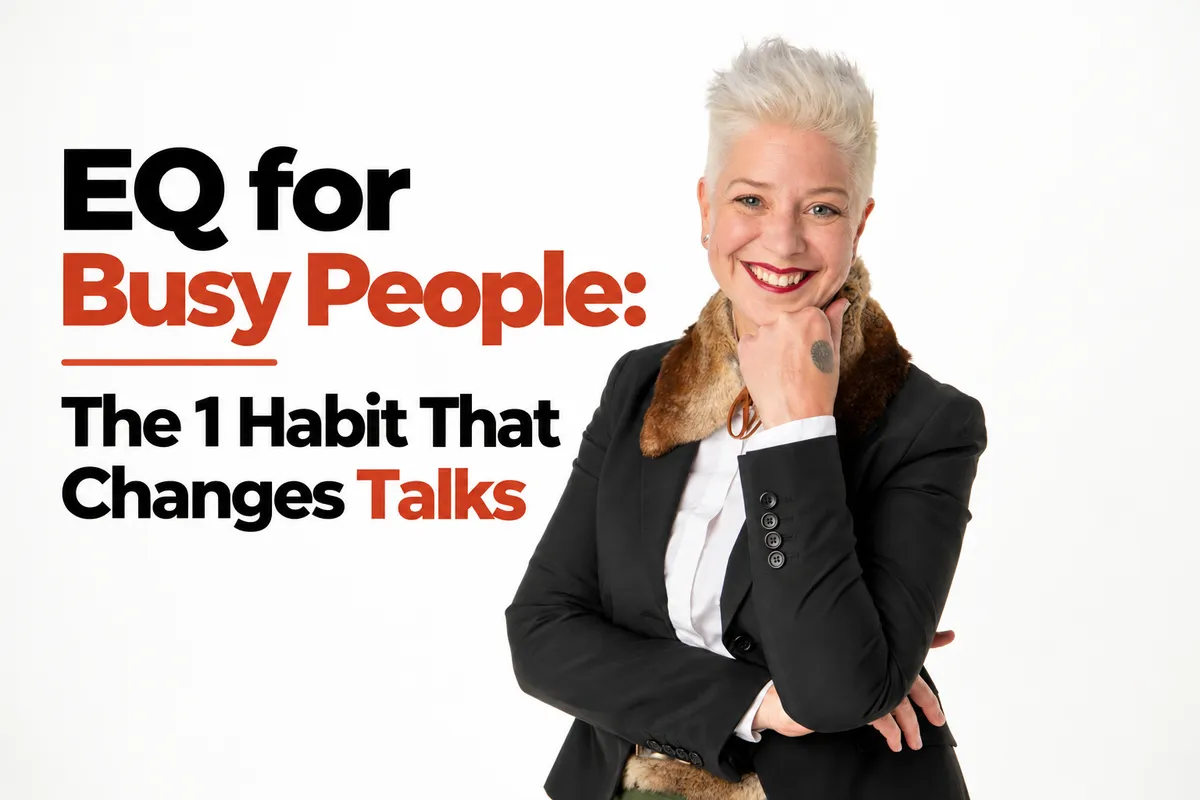
EQ for Leaders: Improve Every Conversation
EQ for Leaders: The 1 Habit That Improves Every Conversation
The best leaders in any room are rarely the smartest people in it. They are the ones who can read a tense meeting, catch the frustration behind a clipped email, and respond in a way that keeps people talking instead of shutting down. That skill has a name. It is emotional intelligence, and it shapes how people experience your leadership more than almost anything on your resume.
Picture two versions of the same moment. A team member walks into your office and says the project is behind schedule because a vendor missed a deadline. In the first version, the leader sighs, says "we don't have time for this," and walks off to fix it alone. In the second version, the leader pauses, says "that's frustrating, let's look at the options together," and the conversation turns into a plan instead of a shutdown. Same problem, same person, two completely different outcomes, and the only thing that changed was how the leader managed the moment.
Technical skill gets you into the leadership role. EQ for leaders is what keeps your team actually showing up for you once you are there. It is the difference between a manager people tolerate and a leader people trust, and most of that difference comes down to how you handle the conversation happening right in front of you, not the strategy deck you built last quarter.
This matters more now than it used to. Remote and hybrid work, leaner teams, and faster deadlines all mean leaders have less time and fewer signals to work with. A slightly off tone in a message or a rushed reaction in a meeting can spread through a team in hours. Workplace EQ is no longer a nice extra on top of good leadership. It is quickly becoming the baseline.
Quick Answer
EQ for leaders comes down to one repeatable habit: pausing to notice emotion, both yours and the other person's, before you respond. That single pause changes how conversations land, lowers workplace tension, and builds the kind of trust that turns a group of employees into an actual team.
Why Workplace EQ Gets Overlooked
Nobody gets promoted for pausing before they speak. Leaders get promoted for hitting targets, shipping projects, and making fast decisions under pressure. Emotional intelligence rarely shows up on a performance review, so it quietly slips to the bottom of the priority list, even though it is doing more work than almost any other leadership skill in the building.
Part of the problem is that EQ is invisible when it is working. Nobody notices a conversation that went well because the leader stayed calm and asked a good question. People only notice the moments it is missing, like the meeting that went sideways or the email that came across harsher than intended. Because the wins are quiet and the failures are loud, EQ ends up looking optional right up until it causes real damage.
The gap shows up fastest under stress. A leader who is calm and self-aware on a good day can turn sharp and reactive during a deadline crunch, and that shift is exactly when their team is watching closest. Emotional resilience is not tested when things are easy. It is tested when a project is late, a client is upset, or a team member pushes back on a decision in front of everyone.
Left unchecked, this gap does real damage. Misunderstandings pile up because people stop feeling safe enough to ask clarifying questions. Stress spreads through a team faster than any single deadline could cause on its own. Relationships that should be sources of support quietly turn transactional, and once that happens, loyalty and creativity are usually the first things to go.
There is also a slower, harder to see cost. Talented people rarely quit a company on paper. They quit a manager, and more specifically, they quit the feeling of being managed instead of understood. A leader can be brilliant strategically and still lose their best people simply because conversations with them feel unsafe or unpredictable.
The One Habit That Changes Everything: The Pause and Name
Here is the habit, and it takes less than five seconds to use. Before you respond in any conversation that carries some emotional weight, pause for a breath and silently name the emotion you notice, in yourself first, then in the other person if you can read it. Only after that do you speak.
It sounds almost too simple to matter, but this small habit touches every part of workplace EQ at once. It slows down your own reaction long enough to choose a response instead of firing off the first thing that comes to mind. It also forces you to actually look at the person in front of you instead of just waiting for your turn to talk, which is where real relationship skills start to develop.
Try it in three steps the next time a conversation gets tense or important.
Step one: catch the moment. Notice when your chest tightens, your voice speeds up, or you feel the urge to jump in and defend yourself. That physical signal is your cue to pause. Most leaders already have this signal, they have just never been trained to treat it as useful information.
Step two: name it, even silently. Tell yourself what you are feeling in one or two words. Frustrated. Defensive. Anxious about the deadline. Do the same for the other person if their tone or body language gives you a clue, without assuming you know exactly what they feel.
Step three: respond from there. Once the emotion has a name, it usually loses some of its grip on you, and you can choose your next sentence instead of reacting on autopilot. The response does not need to be perfect. It just needs to come from a steadier place than the first impulse did.
What This Looks Like in Real Life
Imagine a team member emails you at 6pm, clearly annoyed, saying the timeline you set is unrealistic. The unpaused response might be a quick, clipped reply defending the deadline. The paused response starts with noticing your own defensiveness, naming it, and then replying with something like "I can hear this timeline is putting a lot of pressure on you, can we talk through it tomorrow morning." Nothing about the deadline has changed yet, but the tone of the entire working relationship just did.
Or picture a leadership meeting where a peer challenges your proposal in front of the group. The instinct is to defend the idea immediately, sometimes more forcefully than the moment calls for. A five second pause, naming the flash of embarrassment or frustration you feel, often leads to a much stronger response, something closer to "that's a fair point, walk me through what you're seeing" instead of a reflexive defense that shuts the conversation down.
Why This Small Pause Works
There is real psychology behind this. Emotional intelligence, a concept popularized by psychologist Daniel Goleman, rests on a few core building blocks: self-awareness, self-management, social awareness, and relationship management. The pause and name habit exercises all four in a matter of seconds, which is part of why it works so well even for leaders who feel like they do not have time for anything new.
Self-awareness comes from simply noticing what you feel instead of acting on it unconsciously. Self-management comes from the pause itself, the small gap between stimulus and response where you get to choose. Social awareness comes from extending that same noticing to the other person. Relationship management comes from the response you give once all three of those have happened, which tends to land very differently than a reaction would have.
Putting a feeling into words also tends to take some of the heat out of it. This is sometimes called affect labeling, and the basic idea shows up again and again in emotional regulation research: naming what you feel helps you manage it, rather than being managed by it. For a leader in the middle of a hard conversation, that half second of naming can be the difference between a response that repairs the relationship and one that damages it.
None of this requires you to become a different personality. Introverted leaders and extroverted leaders can both use this habit just as effectively, because it is not about how much you say, it is about the half second of awareness that happens right before you say it.
The Benefits: Better Conversations, Stronger Teams, Smarter Leadership
Better Conversations
Conversations change shape almost immediately once you start pausing before you respond. People feel heard instead of managed, because your response is actually built around what they said rather than what you were already planning to say. Difficult topics, like a missed deadline or a disagreement about direction, stop feeling like landmines and start feeling like something you can work through together.
This shows up in small ways at first. Team members start bringing you problems earlier, before they have fully escalated, because they trust that the conversation will go somewhere useful. Feedback conversations, usually one of the most dreaded parts of leadership, tend to feel more like a dialogue and less like a verdict.
Stronger Teamwork
Teams take their emotional cues from the top. When a leader models calm, curious responses instead of reactive ones, that tone spreads through the group, and people start extending each other the same patience. Workplace EQ is contagious in both directions, which means a leader who develops it well is quietly raising the emotional intelligence of everyone around them.
Over time, this changes how disagreements play out inside a team. Instead of conflict getting avoided or exploding, it starts getting worked through directly, because people have watched their leader model what that looks like without it turning into a blow up. That single shift often does more for collaboration than any team building exercise.
More Effective Leadership
Better decisions tend to follow better conversations. When you are not busy managing your own defensiveness, you have more attention left for the actual problem, which usually means sharper thinking and fewer decisions made in the heat of the moment. Over time, this reputation for staying steady under pressure becomes one of the most valuable things people say about you as a leader.
It also changes how much information reaches you. Leaders with strong relationship skills tend to hear about problems earlier and more honestly, simply because people are not afraid of how the conversation will go. That earlier warning system alone can prevent small issues from turning into expensive ones.
Practical Techniques to Build Workplace EQ Every Day
The pause and name habit is the anchor, but a few smaller techniques make it stick and extend it into the rest of your leadership style.
Start meetings with a two minute check in. A quick, genuine question like "how is everyone doing today" gives you real information about the emotional state of the room before you need it, and it signals that you actually want to know, not just that you are being polite.
Say the emotion out loud when it helps. Instead of only naming feelings silently, sometimes reflect them back directly: "it sounds like this deadline change is frustrating." This single move often does more for trust and relationship skills than any amount of problem solving, because it tells the other person their reaction makes sense before you move to fixing anything.
Ask one more question before you respond. When someone brings you a concern, resist the pull to jump straight to a solution. One extra clarifying question, something as simple as "what's the part of this that's bothering you most," usually reveals the real issue underneath the surface complaint.
Protect your own recovery time. Emotional resilience is not unlimited. Build small breaks into your day, even five minutes between back to back meetings, so you are not running on empty by your hardest conversation of the afternoon. Leaders who never recover tend to skip the pause entirely, simply because they do not have the reserves left to use it.
Debrief hard conversations afterward. After a tense exchange, take two minutes to note what triggered your reaction and how you responded. This is the same kind of reflection that turns any skill into a habit, and EQ for leaders is no exception.
Watch your written tone as closely as your spoken tone. Emails and messages carry no facial expression or vocal warmth to soften them, which means a rushed message is far more likely to read as cold or annoyed than you intended. Before sending anything written while stressed, a quick reread often catches a tone you would want to soften.
Normalize naming emotions on the team, not just your own. Leaders who occasionally say things like "I'm feeling a bit stretched today, bear with me" give everyone else permission to do the same. That kind of openness, used appropriately, tends to build trust faster than a leader who always appears unaffected.
Common Mistakes Leaders Make With EQ
Even leaders who genuinely want to build workplace EQ tend to run into a few of the same traps.
The first is treating empathy as agreement. Naming someone's frustration is not the same as agreeing their proposed solution is right. You can fully acknowledge how someone feels and still make a different call, and separating those two things is part of strong relationship skills, not a contradiction of them.
The second is over-processing every interaction. The pause and name habit is meant to take seconds, not minutes. Leaders who turn every small interaction into a deep emotional analysis often burn out on the habit within a week and abandon it. Simple and fast is what makes it sustainable.
The third is only using the habit in high stakes moments. EQ for leaders works best as a constant background practice, not an emergency tool you reach for only when a conversation has already gone wrong. The leaders who benefit most are the ones using this pause in ordinary Tuesday conversations, not just crisis ones.
Building the Habit So It Actually Sticks
Like any habit, this one is easier to keep if you start small and specific rather than trying to apply it to every conversation at once. A useful starting point is picking one recurring situation, such as your weekly one on one meetings or your team's Monday check in, and practicing the pause there first.
Once it starts to feel natural in that one setting, it tends to spread into other conversations on its own, simply because you have built the muscle of noticing before reacting. Pairing the habit with something you already do daily, like your morning coffee or your commute, and mentally rehearsing one recent conversation where the pause would have helped, is a simple way to keep it fresh without adding another task to your day.
Progress here rarely looks dramatic. It looks like one fewer tense email, one meeting that stayed calmer than it would have a month ago, one team member who opened up about a problem earlier than usual. Those small shifts are the actual signal that the habit is working, even when nothing about your job title or workload has changed.
EQ as a Long-Term Leadership Advantage
Emotional intelligence is not a soft skill you either have or do not have. It is a trainable one, and it compounds the same way any other leadership skill does. A leader who commits to a small habit like the pause and name practice today will be noticeably steadier, more trusted, and more effective a year from now, without needing a single new technical qualification to get there.
This is also one of the few leadership skills that becomes more valuable, not less, as your responsibility grows. The higher you rise, the more your success depends on other people's willingness to bring you honest information, follow you through hard decisions, and stay through difficult periods. All three of those depend far more on emotional intelligence than on any technical expertise you built earlier in your career.
The leaders people remember are rarely the ones who knew the most. They are the ones who made people feel heard, respected, and safe enough to do their best work. That reputation is built one paused, well chosen response at a time, and it starts with a habit small enough to use in your very next conversation.
Key Takeaways
EQ for leaders is a trainable skill, not a fixed personality trait, and it shapes how people experience your leadership more than technical expertise alone.
A short pause before responding, paired with silently naming the emotion in play, is a fast and repeatable way to build workplace EQ.
Naming an emotion tends to reduce its intensity, which gives leaders more control over how they respond under pressure.
Stronger EQ leads to better conversations, more resilient teams, and sharper decision making across the board.
Common traps include mistaking empathy for agreement, over-processing every interaction, and only using the habit during crises.
Small daily techniques, like meeting check ins and post conversation debriefs, help turn EQ from a concept into a lasting habit.
The habit compounds over time, and its value tends to grow rather than shrink as leadership responsibility increases.
Frequently Asked Questions
What does EQ for leaders actually mean?
EQ for leaders means using emotional intelligence, including self-awareness and empathy, to guide how you communicate, make decisions, and manage relationships at work, not just how you manage tasks and outcomes.
Can emotional intelligence really be learned as an adult?
Yes. Emotional intelligence is built through practice, much like any other leadership skill. Small, repeatable habits such as pausing before you respond tend to produce noticeable change over weeks and months rather than requiring years of work.
How is emotional resilience different from emotional intelligence?
Emotional intelligence is your ability to recognize and work with emotions, both yours and other people's. Emotional resilience is your capacity to recover from stress and setbacks without letting them derail how you lead. The two work together, and building one tends to strengthen the other.
How long does it take to see results from practicing workplace EQ?
Many leaders notice a shift in how their conversations feel within the first few weeks of consistent practice. Deeper changes, like a team's overall trust and communication, tend to build gradually over a few months of steady effort.
Does focusing on EQ mean I have to be softer as a leader?
No. EQ for leaders is not about avoiding hard conversations or difficult decisions. It is about handling those moments with more control and clarity, which usually makes tough conversations more direct and more effective, not less.
What if the pause feels awkward or unnatural at first?
That is normal, and it usually fades quickly. A silent pause of even two or three seconds feels much longer to the person using it than it does to the person on the other end of the conversation, and most people never even notice it happening.
Lead With EQ, Starting With Your Next Conversation
You do not need a personality overhaul to lead with more emotional intelligence. You need one habit, used consistently, starting with the very next conversation that carries some weight. Pause. Name what you notice. Then respond.