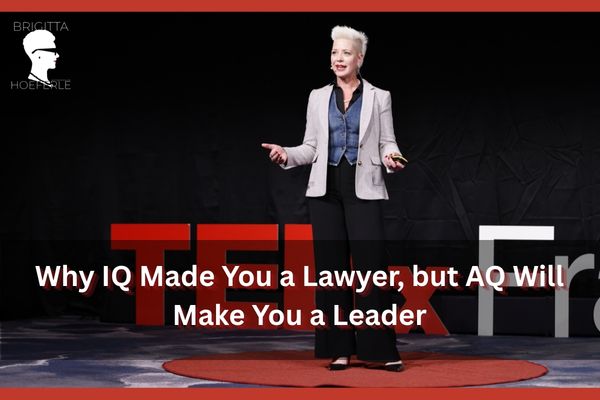
Why IQ Made You a Lawyer, but AQ Will Make You a Leader
Organizational Psychology for Lawyers: The IQ to AQ Leadership Shift
Lawyers are trained and rewarded for intelligence, precision, and analytical strength. However, organizational psychology for lawyers shows that long-term success in the legal profession depends on more than technical expertise. As legal careers progress, leadership increasingly requires adaptability, communication, and the ability to guide others through uncertainty. This article explores why the Adaptability Quotient (AQ) is becoming a critical leadership skill for attorneys and how soft skills training for attorneys, communication training for law firms, and adaptability training for lawyers can help legal professionals move from high-performing practitioners to trusted leaders.
High IQ gets rewarded early in law. It helps you master dense material, spot issues quickly, argue precisely, and keep your thinking sharp under time pressure. It is a real advantage, and it is a big reason you became a lawyer in the first place.
But here is the career truth most lawyers learn the hard way: IQ can build an excellent legal technician, yet still fail to produce an effective leader. If intelligence alone created leadership, the smartest people in a firm would automatically be the best managers, the best team builders, and the most trusted client advisors. In reality, many of the most brilliant attorneys struggle when the job shifts from “do the work” to “lead the people doing the work.”
That shift is exactly where organizational psychology for lawyers becomes a competitive advantage. It focuses on how performance actually happens inside organizations: how decisions are made under uncertainty, how stress changes behavior, how trust is built or destroyed on teams, and how influence works when stakes are high.
IQ made you competent. Leadership demands more than competence.
In most legal careers, the early scoreboard is straightforward: your analytical skill, your writing, your research, your hours, your responsiveness, and your accuracy. Those metrics are closely tied to IQ and technical training. And they matter.
Leadership, however, is measured by outcomes you cannot out-research your way into. As you move into senior associate, counsel, partner, or practice leadership roles, success increasingly depends on whether you can create clarity for others, coordinate under pressure, and build a team that performs without constant rescue.
That is why many firms end up with a familiar problem: high performers who are indispensable individually but inconsistent as leaders. They deliver exceptional work, yet teams around them feel confused, cautious, or burned out. The lawyer may be right most of the time, but still not be effective.
Organizational Psychology for Lawyers: The Missing Operating System
Organizational psychology for lawyers is not therapy, and it is not vague soft skills theory. It is the practical science of behavior and performance in complex environments, applied to the realities of legal practice: deadlines, hierarchy, risk, conflict, and constant evaluation.
It helps explain why smart people make poor decisions under stress, why teams miscommunicate even when everyone is capable, and why client relationships can deteriorate even when the legal work is flawless. It also provides practical tools to improve those outcomes.
When lawyers learn organizational psychology principles, they strengthen leadership behaviors that clients and teams experience immediately: steadier judgment, clearer communication, better prioritization, and stronger influence without aggression.
The Real Separator: Adaptability Quotient (AQ)
Law has always demanded intelligence. Today, it demands something else just as strongly: adaptability. New technology, changing client expectations, pricing pressure, leaner teams, faster timelines, remote collaboration, and evolving regulations have made intelligence only one piece of the leadership equation.
This is where the AQ Adaptability Quotient becomes decisive.
The AQ Adaptability Quotient measures your ability to remain effective when conditions change. It reflects how quickly you adjust your strategy, regulate your reactions, and make sound decisions in uncertain environments. Lawyers with strong AQ leadership skills do not simply react to change they lead through it. They create stability without becoming rigid.
If you have ever watched two attorneys with similar technical ability handle the same crisis differently, you have seen AQ in action. One becomes reactive, controlling, or scattered. The other becomes calm, focused, and decisive. Clients notice. Teams notice. Leadership notices.
Lawyer Performance IQ vs AQ Leadership
Many legal cultures place a heavy emphasis on Lawyer performance IQ—deep analysis, sharp writing, quick problem-solving, strong recall, and technical precision. These capabilities are valuable, but they do not automatically create leadership success.
AQ leadership determines whether intelligence translates into results when circumstances become unpredictable. As responsibilities increase, your role becomes less about having the right answer and more about helping others execute effectively under pressure.
Execution requires alignment. Alignment requires communication. Communication requires emotional control. Emotional control requires adaptability.
The real question is no longer whether you are smart enough. The question is whether you are adaptable enough to keep others performing when challenges arise.
Soft Skills Training for Attorneys: The Highest-ROI Leadership Investment
In law, soft skills are often treated as secondary to technical expertise. In reality, soft skills training for attorneys can be one of the most valuable leadership investments a firm makes.
Effective soft skills training for attorneys develops the behaviors that directly influence outcomes: delegation, feedback, expectation-setting, conflict resolution, relationship management, and client communication.
This is why successful lawyer leadership development programs focus on practical, trainable behaviors rather than abstract theories. Leadership is not a personality trait. It is a collection of repeatable actions that create trust, clarity, accountability, and momentum.
When these skills improve, teams become more efficient, clients feel more confident, and performance becomes more consistent across matters.
Communication Training for Law Firms and AQ Leadership
If leadership is what people experience, communication is where they experience it first.
Communication training for law firms is one of the fastest ways to improve leadership effectiveness because it directly influences the moments that shape trust: leading meetings, setting expectations, providing feedback, managing conflict, handling client concerns, and communicating clearly under pressure.
Most communication failures in law are not caused by a lack of intelligence. They result from stress, assumptions, ambiguity, and unspoken hierarchy.
Strong communication training for law firms helps attorneys replace reactive communication with clear, direct, and solution-focused conversations that reduce misunderstandings and improve collaboration.
When communication improves, collaboration improves. When collaboration improves, performance, engagement, and retention improve as well.
Lawyer Leadership Development Through Adaptability Training for Lawyers
Modern legal leadership requires more than experience. It requires adaptability.
Lawyer leadership development becomes most effective when attorneys intentionally strengthen their ability to navigate uncertainty, manage change, and guide others through challenges.
Adaptability training for lawyers focuses on critical leadership behaviors such as staying flexible without lowering standards, thinking strategically through multiple scenarios, recovering quickly from setbacks, making decisions with incomplete information, and helping teams remain productive during uncertainty.
The goal of adaptability training for lawyers is not to eliminate pressure. The goal is to improve performance under pressure and help leaders create confidence for those around them.
This is where strong AQ leadership becomes a competitive advantage.
IQ Gets You in the Door. AQ Earns You Authority
IQ made you a lawyer. It builds your credibility, expertise, and professional foundation. But leadership in modern law is defined by how effectively you manage people, pressure, and change.
Organizational psychology for lawyers provides the foundation for understanding how people perform in complex environments. Lawyer leadership development helps attorneys build practical leadership capabilities, while soft skills training for attorneys, communication training for law firms, and adaptability training for lawyers strengthen the behaviors that teams and clients experience every day.
In the years ahead, the most successful legal leaders will not simply be the smartest people in the room. They will be the professionals with the strongest AQ Adaptability Quotient, the most effective AQ leadership skills, and the ability to adapt, influence, and lead with confidence under pressure.
Check out more
Influential Leadership Skills for HR Specialists That Work
Executive Communication Training for Healthcare Leadership Success
Best Leadership Qualities That Define Executive Leadership Success
Corporate Training Fuels Sustainable Growth for Renewable Startups