
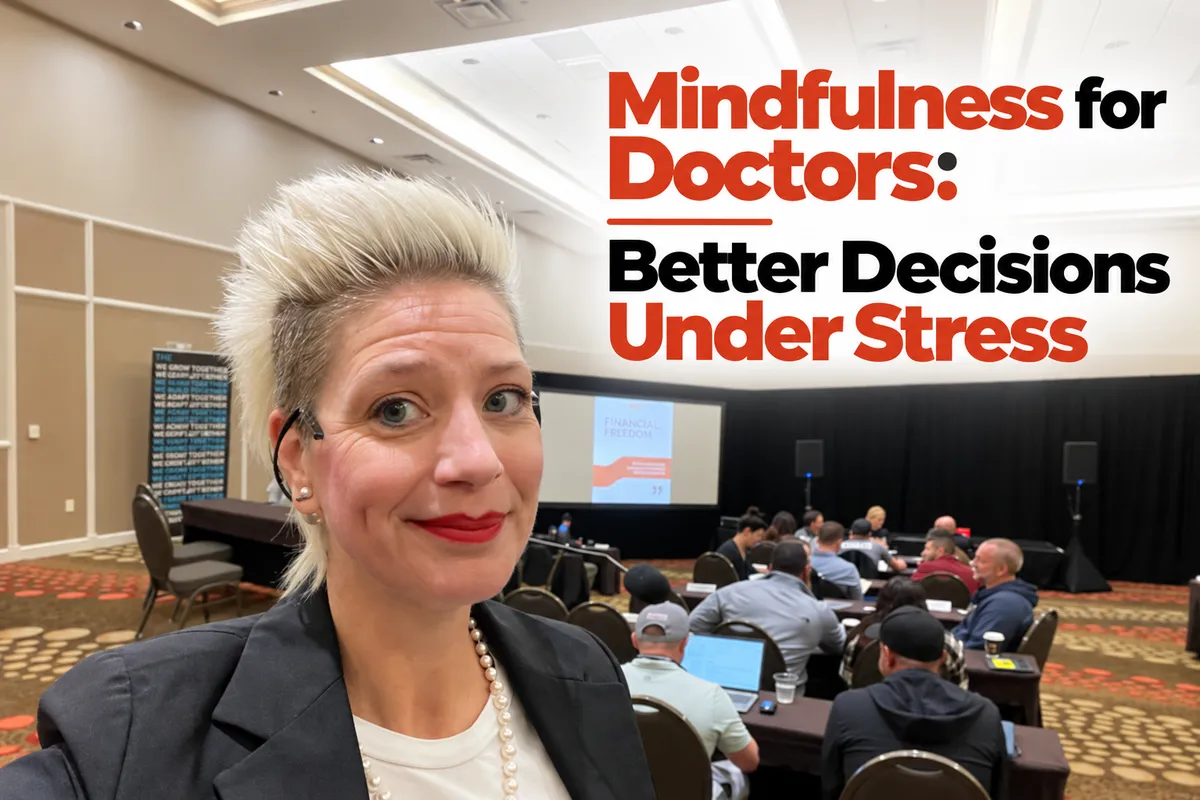
Mindfulness for Doctors Under Stress
Mindfulness for Doctors: Better Decisions Under Stress
Same training. Same symptoms. Different prescriptions, depending only on the clock. A patient walks into a primary care clinic with a sore throat and a cough at nine in the morning. Another patient walks in with nearly identical symptoms at four in the afternoon. A widely cited 2014 study published in JAMA Internal Medicine tracked thousands of these visits and found that clinicians grew steadily more likely to prescribe antibiotics for respiratory infections as their clinic sessions wore on, even when the clinical picture had not changed. The pattern was consistent with decision fatigue, the decline in judgment that can follow prolonged periods of demanding decisions.
That single study captures something most doctors already sense from experience. Medical training sharpens what you know. It does very little to protect how clearly you think after your tenth difficult conversation of the day, a missed lunch, or a second night on call this week. Mindfulness for doctors exists specifically to close that gap, not by adding another task to an already full day, but by changing how you show up for the tasks you are already doing.
Quick Answer
Mindfulness for doctors is the practice of bringing focused, nonjudgmental attention to the present moment, including your own physical and mental state, during clinical work. Research links it to lower physician burnout, steadier clinical decision making, and stronger patient relationships, and it can be practiced in seconds between patients rather than requiring extra time most schedules do not have.
If the word mindfulness just made you want to skip ahead, that reaction is worth sitting with for a second. It is often the clearest sign of exactly how little spare attention is left by the middle of a shift, which happens to be the entire problem this article is about.
Why Mindfulness Gets Overlooked in Medicine
Medical training rewards a very specific kind of intelligence: the ability to absorb enormous amounts of information, recall it under pressure, and act decisively. Attention to your own internal state rarely gets graded on a rotation, so it quietly falls out of the curriculum, even though it directly shapes the quality of every decision built on top of that clinical knowledge.
The gap tends to widen exactly when it matters most. Long shifts and back to back patient encounters draw on the same limited reserve of attention and self-regulation. Physician burnout is not a personal failing that shows up in a small number of especially fragile doctors. It is a predictable outcome of a system that demands sustained, high-stakes focus without building in any structured way to recover it.
Decision fatigue narrows the range of options a tired mind is willing to consider, which helps explain why the antibiotic study above found the easy, familiar choice becoming more common later in the day. Call it the attention tax of clinical work: a toll that gets deducted from judgment over the course of a shift, regardless of how much knowledge or training sits underneath it. Scheduling and compensation built around patients seen per hour add to this, since any practice framed as slowing down, even for a few seconds, can feel like it works against the system rather than within it. That framing is misleading. The practices that actually help take seconds, not minutes, but it explains why so few institutions build them into training.
What Mindfulness for Doctors Actually Means
The idea of applying mindfulness specifically to clinical medicine was formalized by physician Ronald Epstein in a widely cited 1999 paper published in JAMA. Epstein described mindful practitioners as those who pay nonjudgmental attention to their own physical and mental processes during ordinary clinical tasks, rather than running on autopilot through a packed schedule.
This kind of attention is built from a few specific habits: staying attentive to what is actually happening in the room, remaining curious rather than jumping straight to the first familiar diagnosis, staying genuinely present with the patient in front of you, and approaching even routine cases with what Epstein called a beginner's mind, a willingness to notice details a more automatic response might otherwise skip over.
None of this asks a doctor to slow down and second guess every decision. It asks for a different quality of attention during the decisions you are already making, which tends to produce sharper clinical judgment rather than slower, less decisive care.
It asks for a different quality of attention during the decisions you are already making. That distinction, attention rather than more information, is the idea this entire article is built around.
The techniques later in this piece are practical applications built on top of Epstein's framework and the research that followed it. They are not part of his original paper, but a way to translate the same core idea into habits that fit an actual clinical day.
The Benefits of Mindfulness for Doctors
Better Stress Management
A 2009 study published in JAMA followed primary care physicians through an educational program built around mindful communication and found measurable improvements in burnout scores and emotional exhaustion that held up months after the training ended. The physicians were not working fewer hours or seeing fewer patients. They were meeting the same demands with a steadier internal response to them, which is the core of real stress management rather than simply reducing workload.
Improved Clinical Decisions
Decision fatigue thrives on autopilot, reaching for the fastest familiar answer instead of the most accurate one. The attentiveness and curiosity built through mindful practice work directly against that pattern, creating a small pause where a doctor can notice an unusual detail or question an assumption before it hardens into a diagnosis or a prescription. That pause does not guarantee a better outcome, but it creates room for one, which is exactly the room decision fatigue tends to close off.
Overall Doctor Wellness
The same 2009 study also found improvements in empathy and a more patient-centered orientation among participating physicians, alongside the burnout gains. Doctor wellness and quality of care are not separate outcomes competing for the same limited time. They tend to move together, which is part of why mindfulness training keeps showing up inside physician wellness programs rather than staying confined to general wellness culture.
Where This Matters Most in Clinical Practice
Mindfulness benefits any physician, but the specific application changes depending on the demands of your specialty.
Emergency medicine runs on a constant stream of undifferentiated cases with limited time to gather information. A brief reset between rapidly changing cases helps prevent the details of one patient from bleeding into the assessment of the next.
Surgery demands sustained attention across long procedures, often back to back, with very little room for a lapse in focus. Here, mindfulness looks less like a pause between tasks and more like a trained ability to maintain steady attention for hours at a time.
Critical care involves managing several unstable patients whose conditions can shift within minutes. The value of mindful attention here is in managing cognitive overload, keeping track of what actually changed rather than reacting to every alarm with the same level of urgency.
Primary care involves a high volume of repetitive consultations, where it becomes easy to run each visit on the same mental script. Staying present across visits that look similar on paper is what allows a physician to catch the one that is not what it first appears to be.
Simple Mindfulness Practices for Busy Workdays
None of the following require a meditation cushion or a block of free time, since neither one exists in most clinical schedules. Each fits inside a task you are already doing. These four are the ones worth starting with.
Pause at the door. Epstein has described his own habit of pausing with a hand on the doorknob before entering a patient's room, taking one breath, and consciously setting aside whatever came before. Those few seconds reset your attention before the next encounter begins.
Use handwashing as a built-in reset. You are already required to wash your hands between patients. Use that unavoidable pause to take two or three slow breaths and mentally close out the previous encounter, instead of rehearsing it while you dry your hands.
Take one breath before opening the next chart. A single slow breath before reading a new chart signals your attention to shift fully into the next case, rather than arriving there still half occupied with the last one.
Practice mindful listening for the first sixty seconds. At the start of an encounter, give your full attention to the patient's own words before your mind starts building a differential diagnosis. This brief window often surfaces details that get missed once clinical pattern matching takes over.
Two more are worth adding once the first four feel automatic. Naming a difficult emotion in one word, frustrated, rattled, rushed, after a hard conversation tends to loosen its grip before it carries into the next patient interaction. A sixty-second debrief at the end of a shift, noting what went well and what felt hardest, helps you notice patterns over time rather than processing every event in the moment.
What This Looks Like in Practice
Consider two versions of the same busy Friday afternoon. The hallway smells like hand sanitizer, the tablet in your hand still has the last patient's chart open, and the next room is already waiting. In the first version, a physician moves from one exam room to the next with no transition, carrying the frustration of a difficult family conversation straight into the next patient's visit, and reaching for the fastest, most familiar plan rather than fully re-engaging with a new case.
In the second version, the physician pauses at the door for one breath, silently names the frustration still lingering from the last room, and walks in with attention that belongs fully to the patient in front of them. The clinical knowledge in both versions is identical. Only the second version gives that knowledge a clear channel to actually be used well.
Mindfulness does not give a doctor more knowledge. It helps them access the knowledge they already have, even under pressure. That is the entire case for building these habits in the first place.
Common Misconceptions About Mindfulness for Doctors
A common assumption is that mindfulness requires a formal meditation practice added on top of an already full schedule, or that it slows decision making down. Neither holds up in practice. The version that works in clinical settings is brief and repeated rather than a new block of time, and the attentiveness it builds tends to catch an atypical case faster, not slower.
A more persistent misconception is that this only matters for doctors already showing signs of significant burnout. The research points the other way. Physicians tend to benefit most when these habits are built in before exhaustion sets in, rather than treated as damage control after the fact.
Mindfulness as a Long-Term Investment in Your Career
None of these practices change your training, your patient load, or the structural pressures built into modern medicine. Mindfulness will not remove difficult days, heavy workloads, or clinical pressure. What it can do is help you bring steadier attention and judgment to those conditions, which compounds across an entire career rather than a single shift.
A doctor who practices this consistently is not necessarily facing fewer difficult days. They are simply bringing a steadier, more present version of their clinical judgment to each one, whether that visit happens at nine in the morning or four in the afternoon.
Key Takeaways
Mindfulness for doctors is a clinical attention skill, not simply relaxation or general self-care.
Decision fatigue can affect judgment during demanding workdays, including routine decisions like prescribing.
Brief resets, such as a pause before entering a room, can be built into clinical routines you already follow.
Mindful listening in the first minute of an encounter can help physicians stay present with patients and catch details that pattern matching alone might miss.
Consistent practice may support physician well-being and more patient-centered care, based on structured research programs.
Start with one ten-second reset rather than trying to build a lengthy meditation routine from scratch.
Frequently Asked Questions
What is mindfulness for doctors?
Mindfulness for doctors is the practice of paying focused, nonjudgmental attention to your own physical and mental state while doing clinical work, so that attention and judgment stay sharper across a demanding shift.
Does mindfulness really improve clinical decision making?
Research suggests mindfulness may support attention, self-regulation, and decision quality, although it should not be treated as a substitute for clinical protocols or sound medical judgment.
How much time does this actually require?
Very little. Most effective practices take seconds and fit inside tasks you already do, such as handwashing or pausing before entering a room, rather than requiring a separate block of time.
Will this help with physician burnout specifically, or just general stress? Research on structured mindfulness programs for physicians has shown measurable improvements in burnout indicators specifically, alongside broader gains in empathy and well-being.
Is there real research behind this, or is it just wellness trend language?
The concept has a documented history in medical literature, including a foundational 1999 paper in JAMA and a 2009 JAMA study on physicians who completed a mindful communication program.
Can mindfulness realistically be practiced during a packed clinic day?
Yes. The techniques designed for clinical settings are built for exactly that constraint, using existing pauses in the workday rather than requiring extra time.
Bring More Presence Into Every Decision
You do not need to overhaul your schedule to think more clearly under pressure. You need a few seconds of genuine attention, used consistently, built into the work you are already doing. Start with the next doorway you walk through.