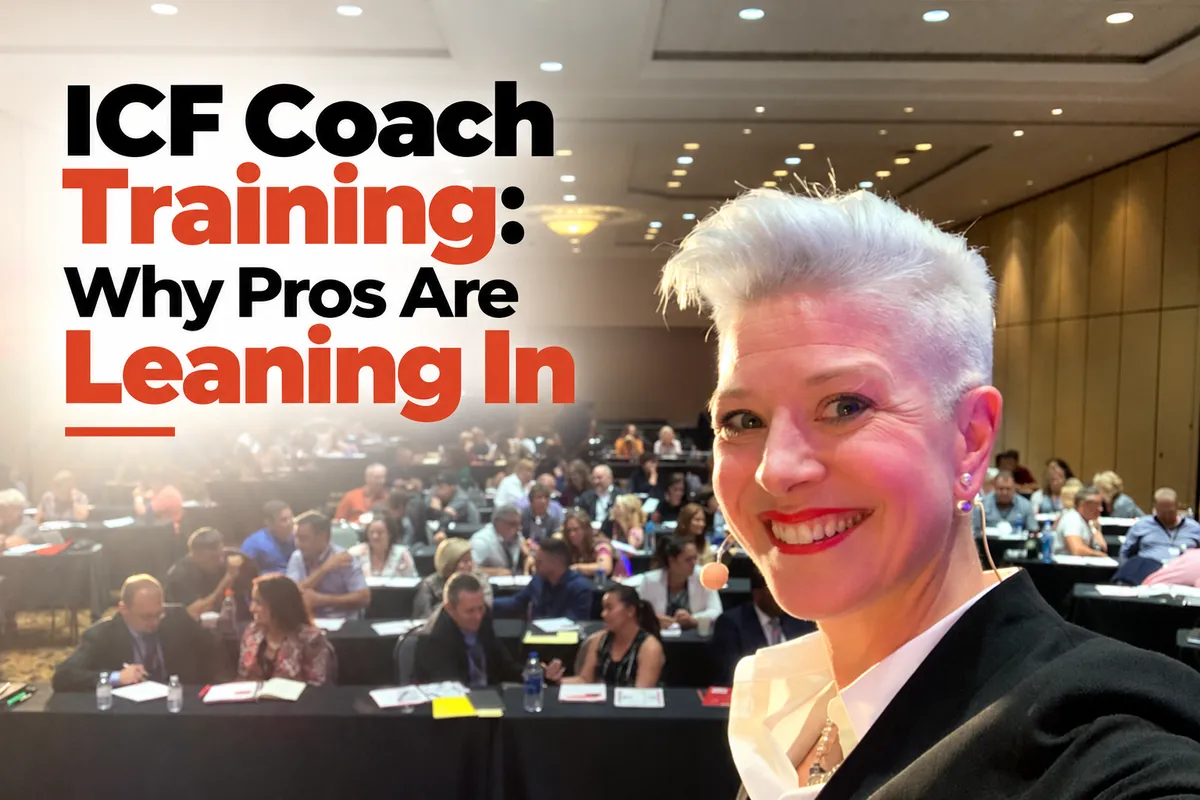
ICF Coach Training: Why Pros Are Leaning In
Being the smartest person in the room used to be enough. It rarely is anymore.
Professionals today can have deep technical expertise, years of experience, and a proven track record. And still struggle to lead a team through a difficult quarter.
Technical Skill Is Not the Same as Leadership
The gap is not knowledge. It is the ability to guide people, ask the right questions, and build real trust.
Trust that makes a team want to follow direction, not just comply with it.
That gap is exactly why so many experienced professionals are turning to ICF coach training. Not as an extra credential to display, but as a genuine skill upgrade for how they lead.
What Great Leadership Actually Looks Like
Think about the best manager or mentor you have ever worked with. Chances are it was not the person with the most technical knowledge in the room.
It was the person who asked good questions. Who listened without rushing to a solution. Who somehow made you want to figure things out for yourself.
That quality often looks like natural talent from the outside. In most cases, it is a learned skill, refined through deliberate practice rather than luck.
For professionals looking to strengthen their coaching and leadership skills, ICF-aligned training can be a practical investment. It is about building a structured, repeatable set of professional coaching skills, the kind that shape how people communicate, how teams develop, and how leadership shows up day to day.
This blog looks at why formal coaching skills get overlooked, what that gap costs in communication and career growth, and how ICF coach training closes it.
Key Takeaways
Technical expertise alone rarely translates into strong leadership without a structured communication skill set.
Skipping formal coaching development often shows up later as weaker team engagement and slower career progression.
ICF certification teaches specific, practice-based coaching competencies, not general soft skills advice.
Leadership coaching built on ICF standards improves how professionals listen, ask questions, and develop others.
Structured coach development can strengthen team communication and support better leadership performance over time.
Why Formal Coaching Skills Get Overlooked
Promoted for the Wrong Reason
Most career paths reward technical mastery first. A professional gets promoted for excellent individual work, whether that is closing deals, managing projects, or solving complex problems.
Leadership responsibility often arrives as a reward for that mastery. Not because someone was actually trained to lead people.
A Common but Invisible Gap
A newly promoted manager may know exactly how to do the job. Yet have no structured training in how to develop someone else who is learning to do it.
They rely on instinct. On what their own managers modeled, for better or worse. On generic leadership advice from a book or a conference session. None of that is inherently wrong, but none of it is systematic either.
Coaching Is a Skill, Not a Personality Trait
Coaching skills tend to get treated as optional, almost like a personality trait some leaders naturally have and others do not. In reality, coaching is a learnable skill set with defined competencies, similar to negotiation or public speaking.
Most professionals never receive structured training in it, because their career path never explicitly required it until they were already leading a team.
Good Intentions, Missing Technique
The result is a leadership style built on assumption rather than practice. A manager might believe they are coaching a direct report through a challenge, when in reality they are simply giving instructions and calling it coaching.
The intention is good. The technique is missing.
This gap tends to widen the longer someone stays in a technical role before stepping into leadership. The actual job has quietly changed from solving problems personally to helping other people solve problems themselves. Nobody explicitly teaches that shift.
The Real Cost of Skipping Structured Coaching Development
When coaching skills are underdeveloped, the effects rarely show up immediately. They surface slowly, in patterns that are easy to blame on something else.
Communication Turns One Directional
A manager who has not developed structured questioning techniques tends to default to telling rather than asking. Even when a team member would benefit far more from working through the problem themselves.
Over time, this can quietly limit a team's ability to solve problems independently. They become conditioned to wait for direction rather than build their own judgment.
Team Growth Plateaus
Without a coaching framework, feedback conversations often stay surface level, focused on what went wrong in a specific task rather than what skills need to develop long term.
Talented team members may reach a certain level of competence and then stall. Not because they lack potential, but because nobody is deliberately coaching them toward the next stage of growth.
Career Progression Slows Down
Professionals who are excellent individual contributors but underdeveloped as coaches sometimes hit a ceiling. Their technical results are strong, but the way they lead does not consistently bring out the best in the people around them.
Senior leadership roles tend to reward the ability to develop others just as much as individual results.
None of this typically gets labeled as a coaching problem internally. It usually gets called a communication issue, a retention issue, or simply someone who "isn't quite ready" for the next role.
The Hidden Cost to a Leader's Confidence
There is also a quieter cost that rarely gets discussed: the leader's own confidence. Professionals who sense their team meetings feel flat, or that feedback conversations go nowhere, often start to doubt their leadership ability in general.
That self doubt can be just as limiting as the visible symptoms, since it can make a capable leader hesitant to take on bigger challenges.
ICF Coach Training as a Practical Solution
ICF certification, offered through the International Coaching Federation, exists to address this gap with a structured, competency based approach rather than general advice.
What ICF Coach Training Actually Teaches
Rather than treating coaching as an abstract leadership quality, ICF coach training breaks it into specific, practicable skills. Active listening. Powerful questioning. Creating awareness. Designing actions that support real growth.
What makes this different from typical leadership workshops is the structure and accountability involved. ICF coach training programs require candidates to practice these competencies directly, often through supervised coaching sessions and structured feedback.
This turns coaching from an intuitive style into a repeatable skill set, one that applies consistently across different situations and people.
How It Changes Everyday Conversations
For professionals already in leadership roles, this training often reframes conversations they were already having, just with far more intention behind them.
A one on one meeting that used to default into status updates can become a genuine coaching conversation. The professional is trained to ask questions that help a team member think through a challenge, rather than simply hand them an answer.
A performance review that used to focus only on outcomes can become a structured conversation about growth.
A Recognized, Structured Credential
ICF certification also brings a recognized standard to professional coaching skills, which matters in workplaces where credibility and consistency are valued. Rather than a leader simply describing themselves as a good coach, the certification reflects a defined, internationally recognized framework.
The credentialing path is structured in stages, which tends to appeal to professionals who want a clear sense of progress. ICF offers three main credential levels, commonly known as ACC, PCC, and MCC.
Each requires a combination of accredited training hours, logged coaching experience, and mentor coaching, with hour requirements increasing at each level. Because these requirements are periodically updated, it is worth checking the current standards directly on the ICF website before planning a specific path.
For someone balancing a full time leadership role, this staged structure often feels achievable rather than overwhelming, since it can be pursued gradually.
A Simple Example of Coaching Skills in Action
The Problem
Consider a mid level manager with a talented team member who keeps missing deadlines, despite clearly having the skills to do the work well.
Without coaching training, the instinctive response is often direct correction. A reminder about the deadline. Closer monitoring going forward.
The Coaching Approach
With ICF based coaching skills, the same manager approaches it differently. Instead of leading with correction, they ask an open question about what is making the deadlines difficult to hit.
Through structured listening and follow up questions, something becomes clear. The team member has been quietly overwhelmed by an unclear prioritization process, not a lack of effort or ability.
The conversation shifts from "you need to hit your deadlines" to a collaborative discussion about how to prioritize tasks more effectively. The team member arrives at their own solution, rather than being handed one.
The Result
The potential result in cases like this is usually twofold. The immediate performance issue can improve, because the actual root cause was addressed rather than masked.
Just as importantly, the team member may develop a stronger sense of ownership over their own workflow, which tends to reduce similar issues down the road.
The effect often does not stop with that one team member either. Other people on the team tend to notice how a difficult conversation was handled, even secondhand, and may feel more comfortable raising their own struggles earlier.
What to Look for in an ICF Coach Training Program
Not all coach training programs offer the same depth. Here is what is worth evaluating before committing time and budget to one.
Check Accreditation Carefully
Programs approved by the International Coaching Federation are designed to align with ICF's curriculum standards, which generally makes their training hours eligible to count toward a credential application.
That said, program accreditation and an individual's specific credential eligibility are not automatically the same thing. Confirm directly with ICF or the program itself how a given course applies to the credential level you are pursuing.
Look for Supervised Practice, Not Just Lectures
Programs with live practice sessions, mentor coaching, and structured feedback tend to build skills more effectively than programs based mostly on lecture or video content.
Coaching is a practiced skill, not a memorized one. The amount of actual coaching practice built into a program often matters more than the polish of its materials.
Consider How It Fits Your Schedule
Many working professionals are not looking to pause their job for this credential. Programs offering flexible scheduling, cohort based support, or part time formats tend to be a more realistic fit than intensive, full time only options.
The Benefits: Communication, Team Development, and Performance
The value of ICF coach training becomes clearer over time, as the skills compound across different situations rather than applying to just one type of conversation.
Better Communication
Professionals trained in structured coaching techniques can become better listeners, asking fewer leading questions and creating more space for the other person to think out loud.
This shift alone can change the tone of team meetings, one on ones, and even difficult conversations.
Stronger, More Self Sufficient Teams
Leaders who apply coaching competencies consistently can develop stronger teams, since team members are coached toward their own solutions rather than simply given directions.
Over time, this may reduce the burden on the leader themselves, since a team that has practiced thinking independently may need less direct oversight.
Broader Workplace Performance
Teams led by professionals with strong coaching skills may show improved engagement, since employees can feel more genuinely heard and supported in their development.
This can contribute to stronger retention, more consistent performance across a team, and a leadership pipeline that develops more naturally.
Why the Effect Compounds
A professional who becomes a better listener is likely to have stronger one on one conversations, which can help build a more capable team. A more capable team can produce better results with less direct oversight, freeing the professional to focus on higher level priorities.
None of this happens overnight. But across a career, this is often where the real value of structured coaching skills becomes visible.
Quick Answers
Is ICF coach training only useful for people who want to become professional coaches?
No. Many professionals pursue it to strengthen their leadership and communication skills within their current role, not to change careers into coaching.
Does ICF certification require a specific educational background?
ICF certification paths are generally open to professionals from a wide range of backgrounds. Requirements vary depending on the credential level being pursued.
How long does it typically take to complete ICF coach training?
Timelines vary by program and credential level. Many structured programs are designed to fit around a working professional's schedule.
Frequently Asked Questions
What is ICF coach training, and how is it different from general leadership training?
ICF coach training is built around specific coaching competencies defined by the International Coaching Federation, such as active listening and powerful questioning. Unlike general leadership training, it focuses on practiced, assessed coaching skills rather than broad concepts.
Who benefits most from pursuing ICF certification?
Professionals in leadership roles, those preparing for leadership responsibility, and independent coaches all tend to benefit. The certification builds a transferable communication and development skill set.
Can ICF coach training improve communication even for experienced leaders?
Yes. Even experienced leaders often discover their communication habits developed instinctively rather than through structured training. ICF coach training can refine those habits into more consistent, intentional practices.
Does ICF certification actually impact career growth?
Career outcomes vary by role and organization. But coaching skills can strengthen capabilities that become increasingly important in senior leadership, particularly developing people and building team capability.
Is ICF coach training worth the time investment for busy professionals?
Many professionals find it worthwhile because the skills apply immediately to everyday work conversations, rather than requiring a separate context to practice.
Does it matter which ICF accredited program I choose?
Yes, to a degree. All accredited programs meet baseline ICF standards, but they can vary in teaching style, supervised practice, and scheduling flexibility. It is worth comparing a few options against your own needs.
Ready to Build These Skills
Leadership built on instinct alone tends to plateau. Leadership built on structured coaching skills tends to keep developing, both for the professional and for the people they lead.
If communication, team development, or career progression feel like a ceiling rather than a path forward, that is worth paying attention to.
Structured ICF coach training offers a practical way to close that gap, one conversation at a time.